
I recently read a blogger's review of a new book, Killing Calvinism here. Surprisingly, there are apparently (only!) eight ways that a Calvinist can kill Calvinism; I found the most notable to be the last, "Scoffing at the hang-ups others have with Calvinism." Apparently, "scoffing at the hang-ups others have with Calvinism" is an Internet faux pas, because everyone has something they love to hate about Calvinism. In fact, some have mastered the art and reasoning behind hating Calvin, and are quite satisfied because of it.
So let me take this opportunity to be honest and confess, by all means, that I have played this particular 'scoffing' hand at the Killing Calvinism poker table at one time or another. As difficult as it may be for any of you to believe, I am guilty of scoffing at the hang ups others have with Calvinism. Now, mine is not your typical Internet scoffing (which happens to manifest itself most profoundly on the blogs of atheists).
My scoffing is more of a mild, tongue-in-cheek, "come on, are you really serious?" kind of scoffing. Most recently I manifested this scoffage on a blog discussion with a group of Southern Baptists who for the life of them can't figure out what kind of theological reputation they want to cling to in the SBC (Southern Baptist Convention). During the discussion, they were arguing about why Calvinists, Non-Calvinists, Anti-Calvinists, Traditionalists, etc., could or could not be considered worthy monikers for the capstone of their doctrinal title deed to being Southern Baptist. I was just lurking on the site until I came across this comment related to the infamous Michal Servetus incident:
My scoffing is more of a mild, tongue-in-cheek, "come on, are you really serious?" kind of scoffing. Most recently I manifested this scoffage on a blog discussion with a group of Southern Baptists who for the life of them can't figure out what kind of theological reputation they want to cling to in the SBC (Southern Baptist Convention). During the discussion, they were arguing about why Calvinists, Non-Calvinists, Anti-Calvinists, Traditionalists, etc., could or could not be considered worthy monikers for the capstone of their doctrinal title deed to being Southern Baptist. I was just lurking on the site until I came across this comment related to the infamous Michal Servetus incident:
There would be some merit in the Calvinist side not being called Calvinist, since the only real agreement with Calvin is on soteriology and not on paedo-baptism, church-state agreement, heretic-burning, and a myriad of other issues.
This comment got the better of me and soon I found myself privately snickering as I considered how to unleash my mild mannered scoffing. What could I say about the Servetus incident to get them to evaluate their theological convictions on burning heretics? Please don't misunderstand me, scoffing about the Servetus incident can be considered to be in very bad taste as it is actually a sad commentary on historical Christianity in many respects; or ... is it?
Before I share with you my first 'scoff' that got the whole thing rolling among several of the bloggers, I'll give you some background. For those of you who do not know who Servetus was, let me introduce you to him briefly.
Before I share with you my first 'scoff' that got the whole thing rolling among several of the bloggers, I'll give you some background. For those of you who do not know who Servetus was, let me introduce you to him briefly.
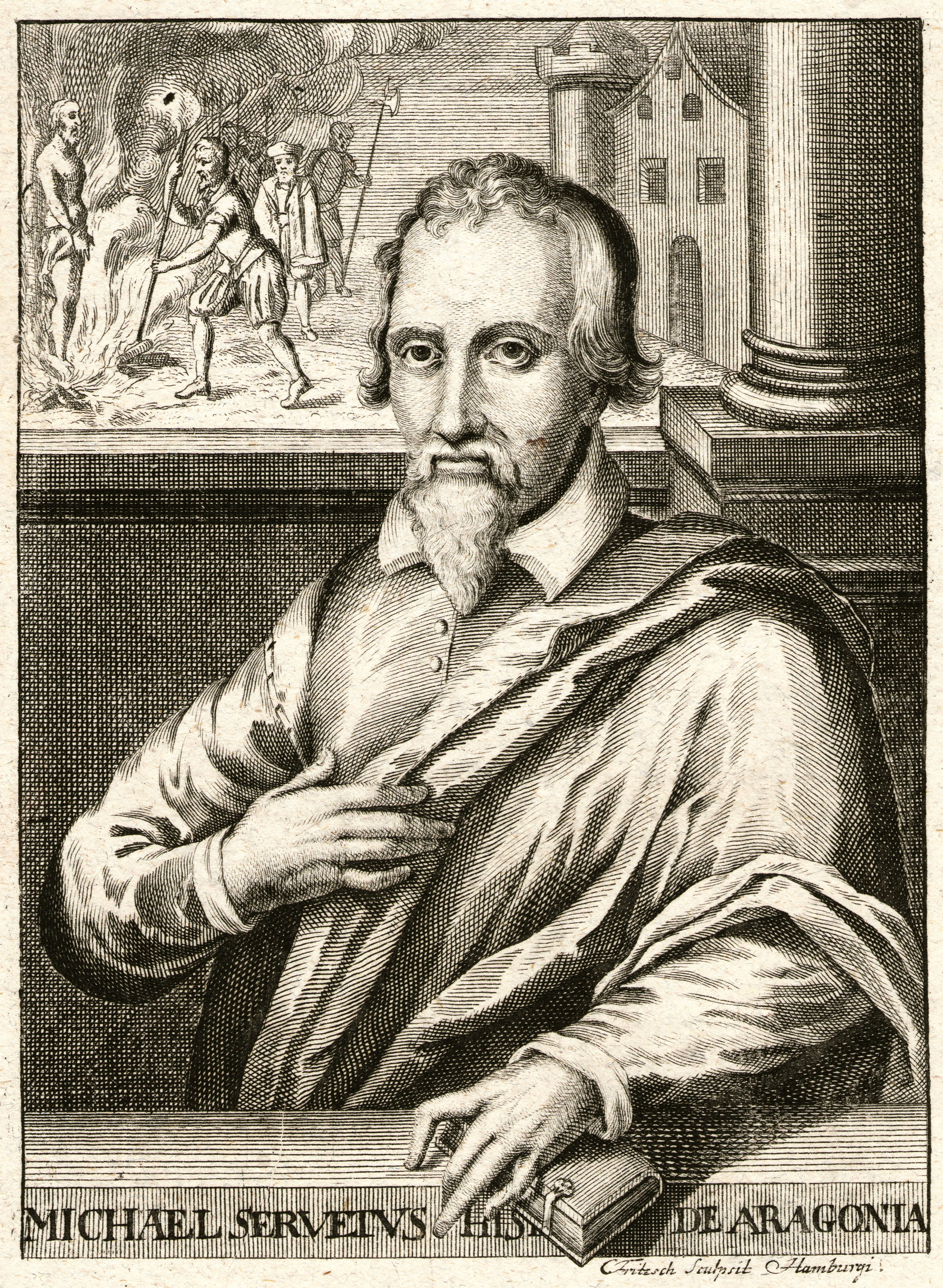
Michael Servetus (also Miguel Servet or Miguel Serveto or Michel de Villeneuve), was a Spanish theologian, physician, cartographer, and humanist. He was the first European correctly to describe the function of pulmonary circulation.
"These are some of the adjectives that were conjured up in the minds of the early sixteenth-century evangelicals when they reflected on the word heresy: blasphemous, scandalous, venomous, abomination, infectious. In fact, these were just a few of the words used to describe the opinions of a man who, failing to acknowledge that his beliefs were filled with theological errors, was to be tied to a stake and burned alive for his transgressions."
"Miguel Servetus was led outside the city of Geneva on October 23, 1553, and burned alive for the crime of heresy. As he walked to his death that day, these fateful words fell from his lips, “Jesus, thou son of the eternal God, deliver me!” And but for the transposition of a single adjective in that sentence, his life would have been spared! How careful and exacting were the theologians of old!
"Yet Servetus would not renounce his theological premise that the church’s view of the Trinity was a three-headed dog that guarded the gates of Hades in Greek and Roman mythology."
"He rejected the mystery of the Trinity in his final breath by meaning that Jesus was not Eternal Son; he was merely a human and became divine. His adamant grip on this theological misconception would not allow him to rescind and say that Jesus Christ is the Son of God from all eternity!"
"It was said of Servetus by the judges in his trial: 'You have promulgated false and thoroughly heretical doctrine, despising all remonstrances and corrections...and with malicious and perverse obstinacy sown and divulged...opinions against God the Father, the Son and the Holy Spirit, in a word against the fundamentals of the Christian religion, and that you had tried to make a schism and trouble the Church of God by which many souls may have been ruined and lost… ...you have neither shame nor horror of setting yourself against the divine Majesty and the Holy Trinity...For these and other reasons, desiring to purge the church of God of such infection and cut off the rotten member...we now condemn you...to be burned with your books to ashes. And so you shall finish your days and give an example to others who would commit the like.' [Hans Hillebrand, ed., The Reformation (Grand Rapids: Baker Book House, 1994), 290. Quoted from Hunted Heretic, Roland Bainton, p. 207–209].
Clearly, the judges believed that the extent to which his theological opinion had strayed from Christian theology could indeed potentially pollute the thinking of the church. And so to stop the spread of this heresy, there seemed to be no other solution than to burn him alive with his writings. Note the reasons again for the charges of heresy: “...sown and divulged opinions against the Trinity...against the fundamentals of the Christian religion...tried to make a schism and trouble the church...setting yourself against the divine majesty.”
It was said that even while the now-famous theologian and prosecuting attorney John Calvin pleaded with him at the end to renounce his “rhapsody patched together from the impious ravings of all the ages,” remarkably, there remained the hint of a question as to whether or not he should be executed among those who witnessed the ensuing travesty. How could “[Servetus], a man so far from orthodoxy, be, nevertheless, fundamentally pious and earnest in the quest for truth?
This was my first 'scoff' that got the whole thing rolling:
"Servetus deserved it. As he walked to his death that day, these fateful words fell from his lips, “Jesus, thou son of the eternal God, deliver me!” And but for the transposition of a single adjective in that sentence, his life would have been spared! How careful and exacting were the theologians of old! Nobody cared if he was an Arminian, Traditionalist, neo-Calvinist or Southern Baptist. He was a heretic. At least the theologians of old knew where they stood on their theology."
I soon discovered that if you want to get a conversation going with a bunch of Southern Baptists, sometimes you have to step out on a limb, like this police officer did.
 I think some of the comments that followed were actually comments any person of sound mind would make in light of what I had just written:
 I think some of the comments that followed were actually comments any person of sound mind would make in light of what I had just written:
"Wow. Do you really believe that at any time in the New Testament era it is acceptable for someone to be executed for their religious beliefs?"
I replied: "I believe Servetus' execution would be considered to be within New Testament times, and its acceptability needs to be looked at in terms of what was considered acceptable then, and not now."
“If you have witnessed a human being or even a farm animal be burned alive unto death and you can still, with sound mind and completely competent faculties, state that Michael Servetus, deserved what he got at the hands of other men, something is lacking in you that is far more sever [sic] than was Sevetus’ heresy.”
[One guy just kept repeating this statement or versions of it over and over again].
Another blogger defended his position with this comment: "It is not for man to execute that judgment."
I replied, "Well, that's not what 1 Peter 2:13-14 teaches is it? "Therefore submit yourselves to every ordinance of man for the Lord's sake, whether to the king as supreme, or to governors, as to those who are sent by him for the punishment of evildoers and for the praise of those who do good."
Further on that same blogger wrote: "There were many things legal in the 1500's that we now find to be reprehensible. That Servetus had violated the laws of his country and was punished within the scope of those laws does not make it right…"
Again, seeking to finally make my point, I said, "As Francois Wendel stated in his translation of Mairet's Calvin, 'It is contrary to a sound conception of history to try to apply our ways of judging and our moral criteria to the past.' The point is that all the Genevan Reformers shared the conviction that it was the duty of a Christian magistrate to put to death blasphemers [who's heresies] kill the soul, just as they punished murderers who kill the body. That does not mean that any modern Calvinist justifies murdering heretics today; it simply means that then it was considered legal and moral. That is a fact, regardless of how hard it is to swallow. The question should not be, it seems to me, why don't I see it as being reprehensible, but, why didn't they see it as reprehensible?"
Oddly enough, he even rationalized the following: "Freedom of conscience must include the freedom to believe and think in ways that we find either reprehensible or even just silly. It is tragic that our forebears in the faith of Christianity found it necessary to use physical force to drive spiritual conformity."
On the surface this sounds good, but on a deeper level it appears to suggest that, though "our freedom of conscience must include the freedom to believe and think in ways that we find either reprehensible or even just silly," our freedom is limited to only doing things that some people approve of.
I responded: "In other words, our consciences are never apparently free enough to believe and think that someone should be executed for heresy. I would surmise then, that "it is [NOT] tragic that our forebears in the faith of Christianity found it necessary to use physical force to drive spiritual conformity;" if your previous statement is true, and their consciences so constrained them to do so by laws instituted by the Magistrates."
I responded: "In other words, our consciences are never apparently free enough to believe and think that someone should be executed for heresy. I would surmise then, that "it is [NOT] tragic that our forebears in the faith of Christianity found it necessary to use physical force to drive spiritual conformity;" if your previous statement is true, and their consciences so constrained them to do so by laws instituted by the Magistrates."
So at the risk of appearing mentally incompetent, can one be in their right mind and execute a heretic? That seems to be the question of the day -- and apparently, anyone who says yes, may have just proved their mental incompetence; to which I reply, were all those in favor of it in Calvin's day mentally incompetent?
Let's face it: Burning a heretic conjures up hideous, unbearable images. To most of us, there can't be anything more violent and disturbing than the image of a man burning to death. So on what possible grounds can Servetus' execution be defended? On what possible grounds can one suggest that Calvinism shouldn't continue to be a hated historical theology? Well ……
Even when Sebastion Castellion published, some months after Servetus's death, a collection of impressive testimonies hostile to Calvin and against the employment of violence in matters of faith, his publication was met with a feeble response by all. Yep. There was pretty much mutual agreement that Servetus's death was necessary. Not only necessary, but legal, acceptable and unanimous. So what gives? Didn't any of those folks suffer from a guilty conscience about this God-awful execution?
Tolerance in the sixteenth century was not and could not be, anything but a sign of religious opposition or utter apathy. Melanchthon even said in a letter to Calvin "… I return thanks to the Son of God who was your arbiter." In response to Castellion's publication, Calvin defended the Augustinian principle of repressing heresy by the secular sword.
So let me suggest that defending Servetus' execution is founded on the grounds that it was instituted by Magistrates of the law, and therefore, I believe one could argue that on Biblical grounds it was necessary, as God said to “submit yourselves to every ordinance of man for the Lord’s sake” (1 Peter 2:13-17); and, it was considered morally right and less evil than allowing a heretic to lead people astray eternally through one’s heretical opinions.
As a minor point to keep in mind, Servetus knew the law of the land and the religious environment and had ample opportunity to repent of his heresy, yet refused, knowing full well the consequences.
Now, the fact that this event occurred 459 plus years ago doesn’t make a bad thing better; it does, however, make it virtually irrelevant in terms of how we understand Calvinism today. No Calvinist today, as much as the Southern Baptist folks who rave on about the Servetus incident seem to think Calvinist's do, favors executing heretics on any grounds. But something occurred to me as I was reading another blogger's response that really hit the nail on the head for me. He wrote:
“I am simply saying that we ought with the strongest language and straightest moral compass decry the evil actions of those who condemned a man to burn to death in the name of God. That you do not see a problem with that is absolutely unbelievable to me as a Baptist–and more so, as a human being. I think your attitude represents the worst that religion offers. That’s just my opinion offered to counter yours."
I believe no lawyer could have had a better defense thrown into his lap. This was almost providential in my mind. I responded, "I would suggest that that is *exactly* what the Reformers were attempting to do ... with the strongest language and straightest moral compass, decry the evil actions of those who condemned a man to burn (in eternity).
Or do you suppose that there is nothing that can be found extraordinarily evil about heresy? Do you just think that it’s simply an ineffective, less than rational theological position, that when it’s all said and done, heresy really isn’t something anyone should worry about? [On every conceivable level -- morally, politically, socially, humanly, religiously speaking …], you are suggesting that it is far worse to kill a heretic (however that’s done) than to let his heresy impact the spiritual lives of those he communicates with."
I would contend that every one of those who favored the execution of Servetus were doing exactly what you said should be done, and justified it in this manner: “We ought with the strongest language and straightest moral compass decry the evil actions of those [heretics] who condemn a man to burn [in hell, yet NEVER to the death] in the flames of the eternal fire,” because that is what happens to anyone who is seduced by their heresy. And their reasoning was simple enough: there is nothing more damning than the eternal damning of heresy. Nothing. That I believe, was their motivation. And what those who hate Calvin for this incident do, is decry the action, entirely missing the seriousness of heresy from their myopic perspective."
That was apparently the end of the conversation from all the Baptists on that blog. So, do you too need a reason to re-evaluate why you use the Servetus incident 459 plus years later to continue your hatred of Calvin? I hope not.


